




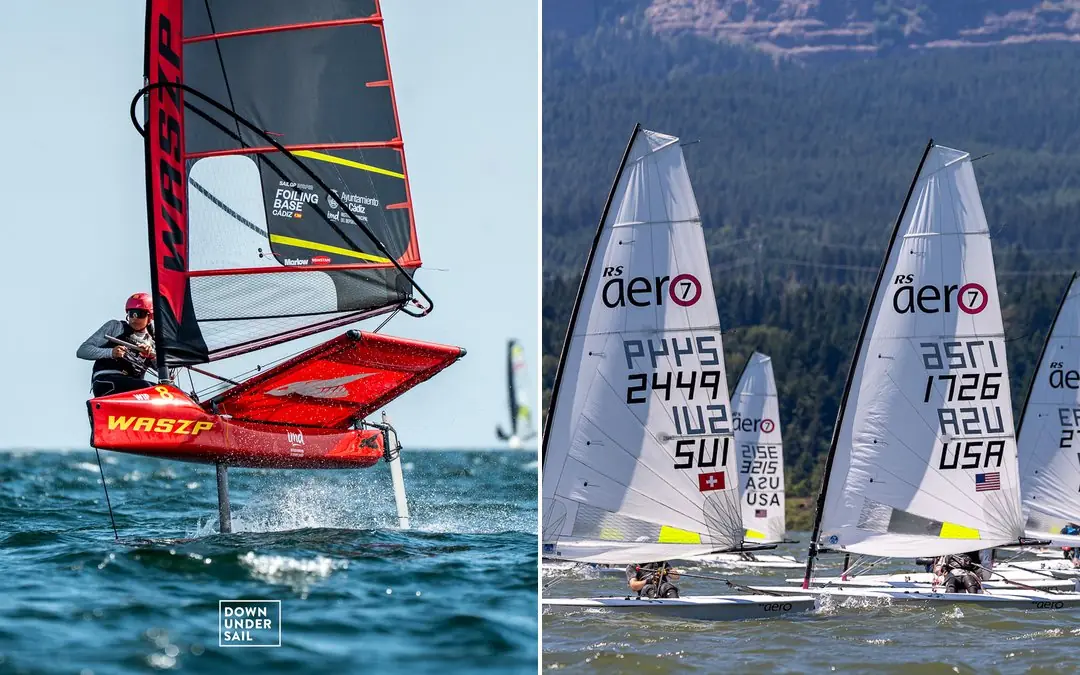
World Sailing has granted World Sailing class status to the WASZP, the RS Aero 6 and the RS Aero 7. Here is what changes for each boat and what it could mean for sailors in Spain.
The World Sailing Council made the decision on 21 November 2026 in Qingdao (China), during its Annual Conference. The approval is subject to the final signing of the contracts. These are the only classes to receive this status in 2026.
What does World Sailing class status mean?
A World Sailing class can run official World Championships backed by the international federation. It has internationally appointed race officials. And it gives national federations a clear framework for including the boat in their programmes.
What changes for the WASZP?
The WASZP, the one-design singlehanded foiler, has brought foiling within reach of thousands of sailors. In its first ten years it grew on its own, with its own fleets, events and community outside the traditional class structure.
The class submitted its formal application in December 2024. It then took two key steps:
- In June 2026 it set up the WASZP International Class Association (WICA), a sailor-led association with its own constitution.
- It adopted the 2026 Class Rules, written in the standard World Sailing format.
The WICA remains the authority for the class rules. Strict one-design does not change. What the class gains:
- Championships with official World Championship status.
- A more unified framework for national associations and more consistent events from country to country.
- Easier access to the youth and development programmes run by federations.
Andrew McDougall, the WASZP's designer, points out that the aim has always been to make foiling accessible to more sailors. Jervis Tilly, President of the WICA, says that reaching World Sailing status ten years after the boat first sailed is a milestone for the class.
The class is very active in Spain. It already holds its own Spanish Championship: in El Masnou in 2025 and in Murcia in 2026. The 2026 Europeans were sailed on the Mar Menor, with 119 sailors from 16 countries, and Antonio Gasperini won the overall title.
What changes for the RS Aero 6 and the RS Aero 7?
The RS Aero, the ultralight singlehanded dinghy designed by Jo Richards and RS Sailing, has been a World Sailing class since 2015. A single hull takes four rigs: 5, 6, 7 and 9. This lets sailors of very different weights and ages race with the rig that suits them best.
World Sailing has now approved separate World Sailing class status for the RS Aero 6 and the RS Aero 7. The RS Aero 6 is popular with young and lighter sailors. The RS Aero 7 is the mid-range rig. With this step, each rig strengthens its path in international racing.
What could change for sailors in Spain?
RFEV National Class
The WASZP is already a Class of Interest of the Royal Spanish Sailing Federation (RFEV) and holds its own Spanish Championship. As an international class recognised by World Sailing, it now meets one of the requirements to become a National Class. The other is having a large enough fleet across the regional federations.
High-Level Athlete status
The new status also opens the door for results in these classes to count towards High-Level Athlete status (Deportista de Alto Nivel). It is governed by Real Decreto 971/2007, which takes into account World and European Championships organised by international federations. With official World Championships recognised by World Sailing, the path is clearer. The final decision always rests with Spain's National Sports Council (CSD), based on the result and the international entry of each championship.
An example: under the current criteria, several Spanish sailors could have applied for this status if these championships had already held official World Sailing status. At the last WASZP Games in Pensacola, Antonio Gasperini was 2nd and Pablo Astiazaran and Sol López were 3rd overall. At the last Europeans, Antonio Gasperini and Alberto Morales were 1st and 2nd, and Miguel Ángel Morales was 4th.
What are the benefits of High-Level Athlete status?
- Education: at least 3% of university places and 5% of vocational training places are reserved, with a specific quota in sports science, physiotherapy and physical education teaching. Universities must also allow changes to timetables, groups and exams that clash with competitions.
- Public sector jobs: it counts as a merit in public examinations that assess specific merits, and for entry into the security forces and the Armed Forces. Attending and preparing for official international competitions counts as paid leave.
- Duration: five years from publication in Spain's Official State Gazette (BOE), or seven for Olympic or Paralympic medallists.
- Tax: tax advantages on some training and development grants, and on savings through the athletes' mutual fund.
What are the next key events?
- RS Aero: the 2027 World Championship will run from 16 to 22 January at Blairgowrie Yacht Squadron, near Melbourne (Australia).
- WASZP: the 2027 WASZP Games will be held on Lake Garda. The Junior and Masters Games run from 28 June to 1 July, and the Open Championship from 3 to 7 July. Everything points to this being the WASZP's first official World Championship as a World Sailing class. The class has yet to confirm the details.
The WASZP and the RS Aero 6 and 7 share one idea: modern, light and accessible boats that bring new generations into racing. With World Sailing's backing, clubs and federations have more reasons to include them in their sailing schools, development squads and calendars. You can follow dinghy sailing news in the Proasail.com Journal.
Photos: Down Under Sail / Stawicki Photography.